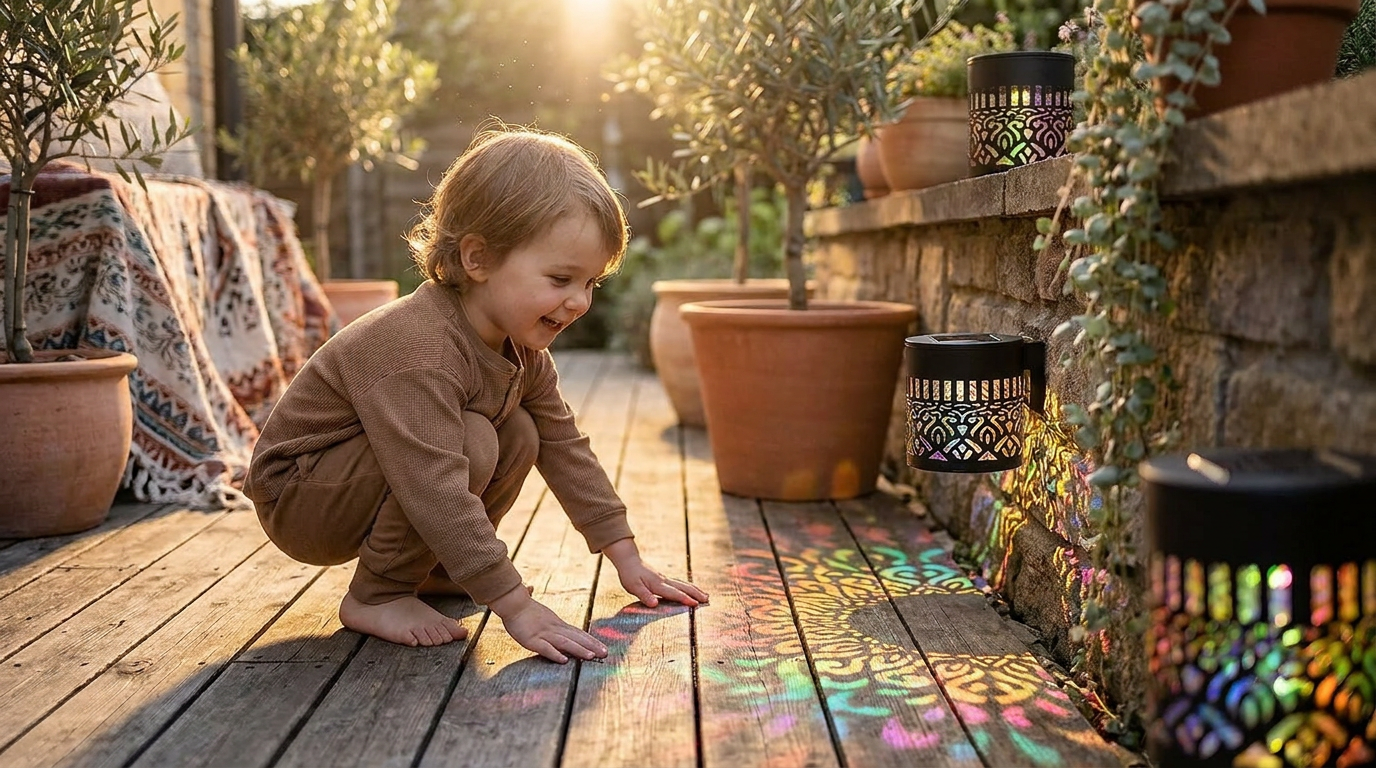
How do Solar Mandala Lights project shadow patterns?
 Maya ChenContributing Editor
June 19, 2026 — Solar Mandala Lights project intricate geometric patterns by utilizing a high-output point-source LED positioned precisely within a laser-cut metal housing that acts as a physical stencil.
Homeowners seeking to replicate the "boho garden" aesthetic often struggle with low-fidelity fixtures that blur at distances exceeding twelve inches. The efficacy of these projection lights depends entirely on the ratio between the LED's surface area and the distance to the aperture. While much of the industry focuses on battery capacity, the real engineering challenge lies in maintaining pattern clarity across uneven terrain like mulch or stone.
How does the light source affect projection clarity?
The conventional wisdom says that a brighter lumen count equates to a better projection, but this is a fundamental misunderstanding of optics. Here's the part nobody talks about: a large, diffused light source actually destroys shadow definition because light rays originate from too many different angles, effectively "filling in" the shadows created by the mandala stencil. Solar Mandala Lights utilize a compact, high-intensity LED chip to mimic a point source, which ensures that light rays remain parallel enough to cast sharp-edged geometric shapes. Run the math: a 1mm LED source will produce a shadow edge that is significantly crisper than a 5mm diffused COB (Chip on Board) array at a standard three-foot throw distance. According to technical reviews of modern landscape lighting by Tool Review sources such as the Linkind SP6 Smart Solar Pathway tests, the transition to smart, controllable projection optics is the only way to maintain pattern integrity as battery voltage fluctuates throughout the night. I'll change my mind when manufacturers can produce clear projections using cheaper, wide-angle plastic lenses, but for now, the physics favors the narrow-beam point source found in premium mandala units.
Why does the housing material matter for pattern geometry?
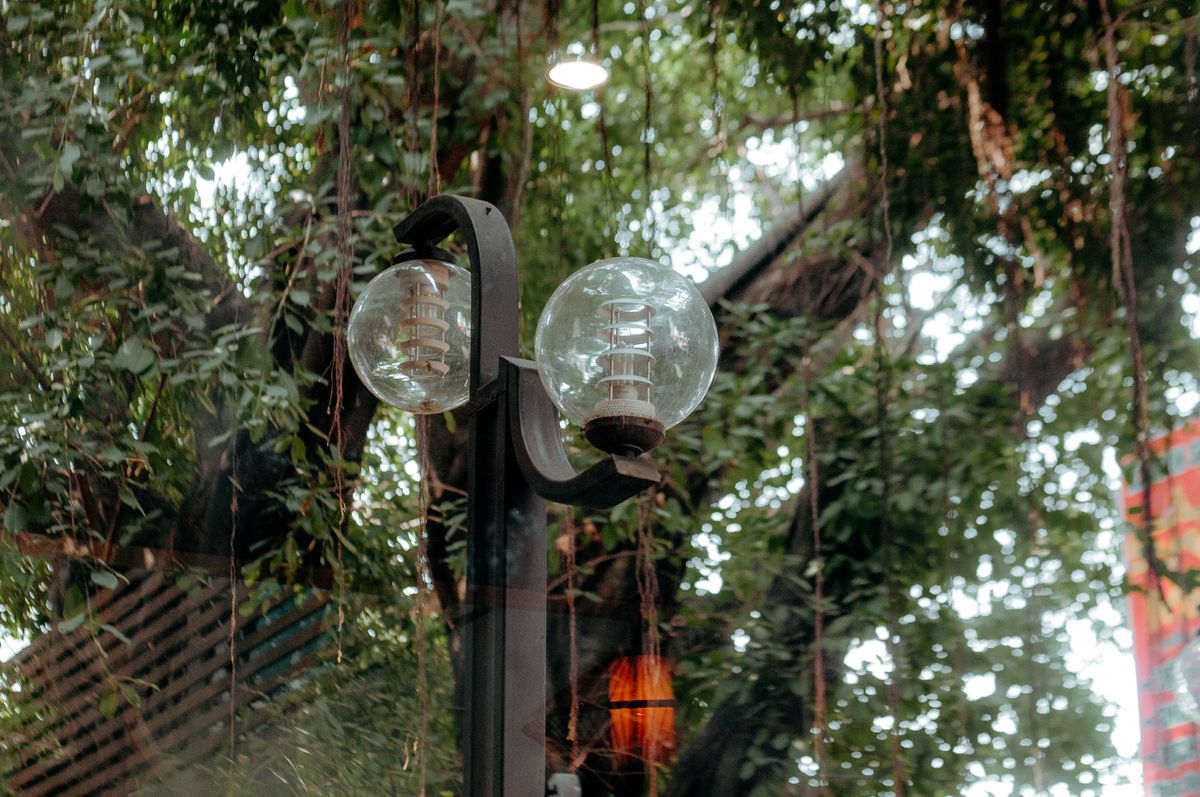
Photo by 🇻🇳🇻🇳Nguyễn Tiến Thịnh 🇻🇳🇻🇳 on Pexels
Most consumers assume the metal casing of Solar Mandala Lights is purely aesthetic, but the housing serves as the optical governor for the entire projection. Plastic housings often suffer from internal reflections that create "ghosting"—a secondary, fainter image that overlaps the primary mandala pattern and makes it look muddy. Precision-cut metal prevents this by absorbing stray photons rather than refracting them. The thickness of the material also dictates the "cutoff angle" of the light; a thicker gauge metal ensures that the light only escapes through the intended geometric voids, preventing light pollution and keeping the focus on the ground pattern. This is why outdoor solar projection lights using thin-stamped aluminum often outperform thicker, cast-iron variants that can inadvertently block the projection's spread. Furthermore, the internal coating of the housing must be non-reflective; a matte black interior is essential to prevent internal bouncing which would otherwise degrade the contrast of the shadow. Without these specific material constraints, a solar lantern is just a light source, not a projection tool.
Quick answers
Q: What is the ideal height for a mandala garden stake to project a clear pattern? A: For a standard Solar Mandala Light, a height of 12 to 18 inches from the ground provides the optimal balance between pattern spread and edge sharpness. If the stake is placed higher than 24 inches, the light intensity drops according to the inverse square law, significantly dimming the mandala effect.
Q: Do these lights work on dark surfaces like grass or dark mulch? A: No, the contrast ratio is significantly reduced on dark, light-absorbing surfaces. A light-colored stone path or a concrete patio provides the necessary reflective backdrop to make the 3000K warm white light of the mandala pattern visible to the human eye.
Q: How long does the projection last on a full charge? A: Most high-quality Solar Mandala Lights are equipped with a 600mAh to 800mAh Ni-MH battery, providing 8 to 10 hours of projection time. However, the projection intensity will visibly dim as the voltage drops below 1.1V, usually occurring after the sixth hour of operation.
Learn more about outdoor solar projection lights and how they compare to outdoor solar projection lights or different styles of outdoor solar projection lights.
Learn more about Solar Mandala Lights at https://solarmandalalights.com.
Sources
Photo by Duy's House of Photo on Pexels