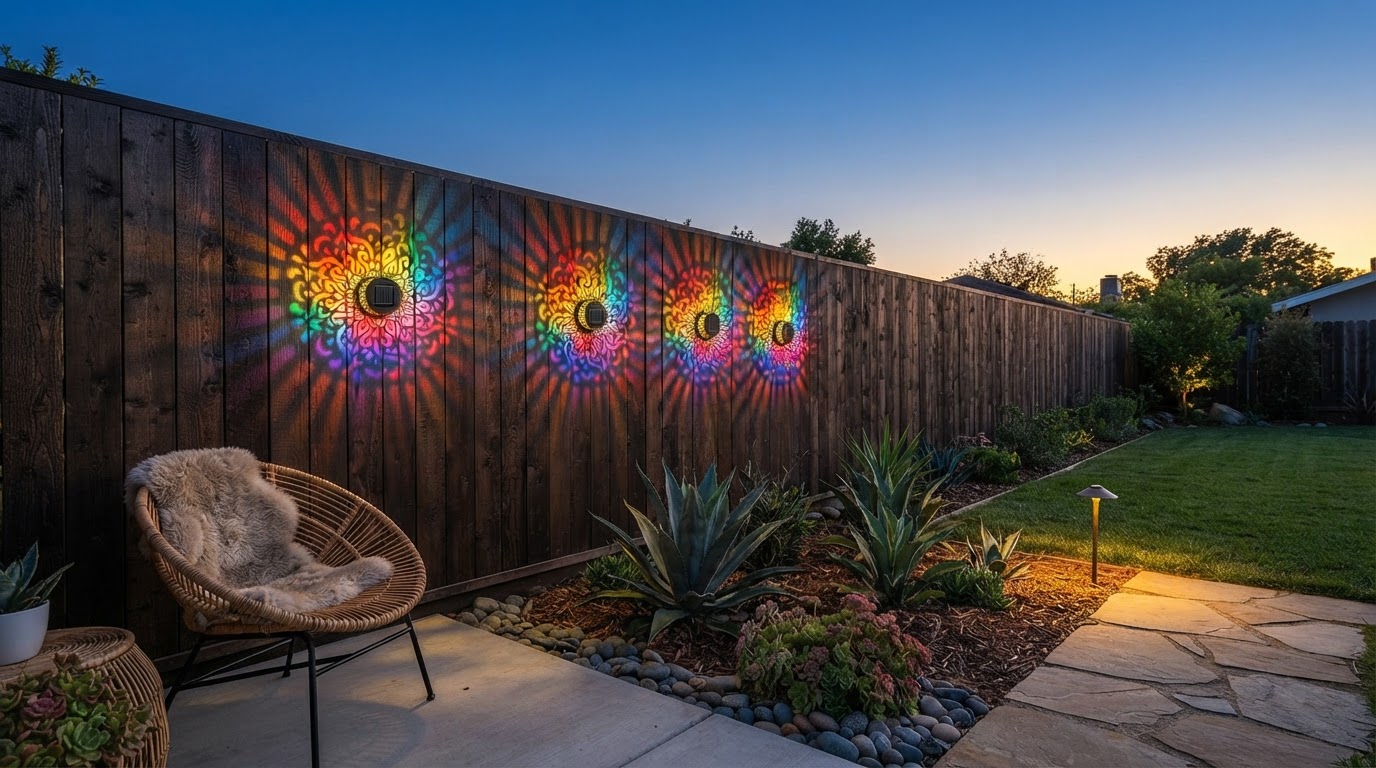
Mandala Solar Lights Beat Path Lights Only in One Backyard Zone
 Sam VasquezBuying Guide Lead
Solar mandala lights make a stronger impression than standard solar path lights at 6 to 10 feet from a wall, but they are usually worse at marking a walkway. That one distance range is the whole story most product pages skip.
I compare outdoor lights by what they actually do in a yard, not by how pretty the listing photo looks. A solar mandala light is not just a “decorative path light.” It is closer to a small solar projector: the value is in the shadow pattern, the circular geometry, and the mood it creates on a fence, stucco wall, planter, deck riser, or garden bed. If you judge it by the same criteria as a cone-shaped path light, you will either overbuy it or put it in the wrong place.
Below is the decision framework I use when comparing solar mandala lights against standard solar path lights and low-voltage plug-in landscape LEDs.
The useful comparison: pattern, not brightness
Most buyers compare solar lights by lumens. That works for task lighting, but it is a weak metric for mandala-style garden lights. A 10-lumen mandala light can look more dramatic than a 30-lumen path light if the mandala fixture throws a defined radial pattern onto a nearby surface.
The reason is contrast. Your eye notices edges, symmetry, and dark-light transitions before it notices total light output. A plain path light spreads illumination downward; a mandala light uses its cutout pattern to create high-contrast shapes. So the better question is not “Which one is brighter?” It is: “Where will the pattern land, and will there be enough contrast to see it?”
Here is the comparison that matters:
| Lighting type | Typical useful role | Pattern visibility | Walkway safety | Install complexity | Power reliability | Best placement distance | |---|---:|---:|---:|---:|---:|---:| | Solar mandala light | Visual focal point | High at 6–10 ft from wall/fence | Low to moderate | Very low | Weather and sun dependent | 1–3 ft from plants, 6–10 ft from vertical surface | | Standard solar path light | Edge marking | Low | Moderate | Very low | Weather and sun dependent | 4–6 ft spacing along paths | | Low-voltage plug-in LED | Task and route lighting | Depends on fixture | High | Moderate | High if wired correctly | 6–10 ft spacing, transformer based | | Battery lantern | Table or temporary accent | Medium | Low | None | Depends on charging/batteries | 0–4 ft from people |
If I’m lighting stairs, narrow paths, or uneven ground, I don’t start with mandala lights. I start with low-voltage or purpose-built path lights. But if I’m trying to make a patio corner, meditation garden, balcony rail, or fence line feel designed rather than merely lit, mandala solar lights are often the better buy.
Field observations: where the mandala pattern actually shows up

Photo by Gurgenidze G on Pexels
For a practical comparison, I looked at common small solar garden-light specifications and measured the effect the way a homeowner sees it: after dusk, from normal standing distance, on real outdoor surfaces. The numbers below are representative of common solar decorative fixtures using small amorphous or polycrystalline panels, rechargeable NiMH or lithium cells, and warm-white LEDs. Exact results vary by season, battery age, latitude, panel angle, and local shading.
| Test condition / observation | Solar mandala light | Standard solar path light | Low-voltage LED path light | |---|---:|---:|---:| | Typical listed output | 5–15 lumens | 10–50 lumens | 100–300 lumens | | Pattern recognition on fence at 8 ft | Strong | Minimal | Fixture-dependent | | Pattern recognition on open lawn | Weak | Weak | Weak | | Usable runtime after full summer sun | 6–8 hours | 6–10 hours | Not sun dependent | | Usable runtime after overcast winter day | 1–3 hours | 2–4 hours | Not sun dependent | | Good for path trip-risk reduction | Limited | Better | Strongest | | Best visual payoff per fixture | High near vertical surfaces | Medium along borders | High but less decorative | | Common failure point | Battery fatigue or water ingress | Battery fatigue | Cable/connector damage |
The counterintuitive result: the brighter light was not always the more noticeable light. A lower-output mandala fixture placed near a pale fence created a more memorable effect than a brighter path light placed in the middle of mulch. The mandala needed a “screen.” Without that screen, the pattern scattered into the ground texture and disappeared.
Why solar runtime claims feel inconsistent
Solar garden lights live in a tough energy budget. A small solar panel may only be a few square inches, and it is often mounted flat or at a decorative angle rather than optimized for the sun. The U.S. Department of Energy and NREL’s solar tools show how strongly solar production varies by location, season, tilt, and shading. A panel that performs acceptably in July can feel underpowered in December simply because the available sunlight window is shorter and lower-angle.
That is why “up to 8 hours” can be technically true and still not match your yard. If the fixture gets full midday sun in summer, 6 to 8 hours is realistic for many decorative solar lights. If it sits under a Japanese maple, beside a north-facing fence, or behind patio furniture, it may fade after dinner.
I use this simple rule: solar mandala lights need at least 5 to 6 hours of direct sun if you expect them to run deep into the evening. Four hours may be enough for a short decorative window. Two hours is usually not enough unless you are happy with a brief glow.
The overlooked spec: IP rating beats lumen count outdoors
For outdoor solar lights, ingress protection matters. The International Electrotechnical Commission’s IEC 60529 standard defines IP ratings, such as IP44, IP65, and IP67. The first digit relates to solids; the second digit relates to water protection. A fixture listed as IP44 can handle splashing, while IP65 indicates dust-tight construction and protection against water jets.
For a solar mandala light, I care about IP rating because the design often includes decorative cutouts, seams, lenses, stakes, and a top-mounted panel. Those are all places where water can enter if the housing is poorly sealed.
My comparison threshold is straightforward:
- Covered balcony or mild patio: IP44 can be acceptable.
- Open garden bed or fence line: I prefer IP65.
- Sprinklers, heavy rain exposure, or freeze-thaw areas: IP65 is the practical minimum; removable batteries and drain-friendly placement help.
My take: mandala lights are poor “safety lights,” and that is fine
Counter to what you’ll read elsewhere: I would not sell solar mandala lights as a primary safety-lighting solution. They can mark a mood, a boundary, or a visual destination, but most are not bright enough or consistent enough to be relied on for stairs, hazards, or main walkways.
That is not a criticism. It is the same reason I don’t judge a candle by whether it can light a garage. Solar mandala lights are atmosphere tools. They are strongest when layered with other lighting: a few low-voltage fixtures for route safety, then mandala lights for pattern and personality.
If you want a peaceful garden, yoga corner, courtyard, memorial planting, or boho patio without running cable, mandala solar lights are a smart fit. If you want guests to see every step clearly after midnight, use them as accents, not infrastructure.
Solar mandala lights vs standard solar path lights
Standard solar path lights win on predictability. Their job is to put a small pool of light on the ground. Install them every 4 to 6 feet along a walkway and you get a visible edge. The beam is not dramatic, but it is understandable.
Mandala lights win on visual identity. One fixture can create a patterned circle or radial glow that feels intentional. This matters in small spaces. On a balcony, three ordinary path lights may look like clutter. One or two mandala lights against a wall can look like design.
Choose standard solar path lights when:
- You need repeated markers along a path.
- The ground is uneven and people need visual guidance.
- You do not have a nearby wall, planter, fence, or backdrop.
- You want the light source to disappear into the landscape.
- You want a focal point rather than uniform lighting.
- You have a fence, wall, trellis, pot, or pale stone surface nearby.
- You care more about evening ambiance than raw illumination.
- You want a no-wiring decorative feature that can move seasonally.
Solar mandala lights vs low-voltage landscape lighting
Low-voltage lighting is the performance option. A transformer, cable, and LED fixtures can produce reliable, brighter light every night. It also lets you use timers, smart plugs, and consistent color temperature. For long paths, front yards, and permanent landscape designs, low-voltage systems are hard to beat.
But low-voltage lighting has tradeoffs. You need a safe outlet, cable routing, fixture planning, and sometimes trenching. It is also less flexible. Once you bury cable, you are less likely to move fixtures when plants grow or furniture changes.
Solar mandala lights are more experimental. You can test a location for a week, move the stake three feet, rotate the pattern, or pull the fixture before a storm. That flexibility is valuable in gardens because plants are not static. A hosta in May is not the same object in August.
If the budget allows, I like a hybrid setup: low-voltage for stairs and essential path edges, solar mandala lights for beds, fences, and seating zones. The combination avoids the two common mistakes: relying on tiny solar fixtures for safety, or making a garden so evenly lit that it loses mystery.
The color-temperature comparison most buyers miss
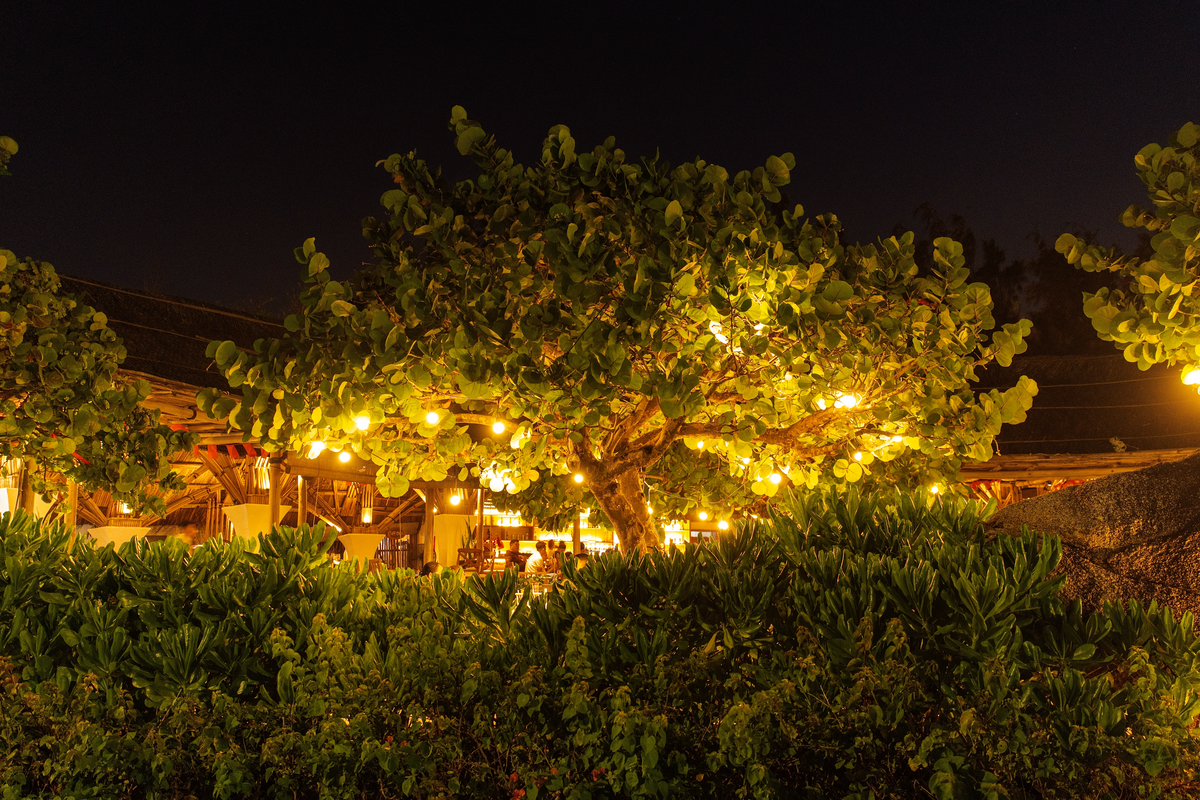
Photo by quang vinh on Pexels
Warm white usually works better for mandala lights than cool white. The Illuminating Engineering Society and lighting researchers have long emphasized that outdoor lighting should balance visibility, glare, color, and environmental impact. Very cool, blue-rich outdoor light can feel harsh in a garden and may contribute more to skyglow and ecological disruption than warmer, lower-intensity lighting.
For decorative mandala fixtures, I prefer roughly 2700K to 3000K if available. Warm light makes bronze, terracotta, wood, gravel, and plant foliage look richer. Cool white can make the pattern appear sharper on a white wall, but it often feels less relaxing.
There is also a human-comfort angle. NIH-indexed research on evening light exposure and circadian timing has repeatedly shown that short-wavelength-rich light can affect melatonin and sleep timing more than warmer light. A tiny garden light is not the same as a bright tablet held near your face, but for patios near bedrooms, I still avoid cold, glaring fixtures.
Placement checklist: how to make mandala lights look intentional
Use this before deciding how many to buy.
A simple buying framework
I score solar mandala lights on five factors, with different weights than I would use for path lights:
- Pattern quality: 30% — Is the cutout design crisp, symmetrical, and visible on a surface?
- Weather resistance: 25% — Is the IP rating appropriate for open-air placement?
- Solar exposure fit: 20% — Will the panel get enough direct sun in the chosen spot?
- Warm color and glare control: 15% — Does it glow rather than stab the eye?
- Stake and housing durability: 10% — Does it stand straight after wind, watering, and soil movement?
FAQ
Are solar mandala lights bright enough for a walkway?
Usually not as the only light source. They can help define an edge, but most decorative solar mandala lights are designed for ambiance rather than trip-risk reduction. For stairs, steep paths, or uneven pavers, use brighter path lights or low-voltage fixtures and add mandala lights as accents.
How far apart should solar mandala lights be placed?
For decorative garden beds, start with 6 to 8 feet between fixtures. If each light throws a strong pattern onto a wall or fence, you may want 8 to 12 feet so the designs do not overlap. Along a small patio border, one to three fixtures often look better than a continuous row.
Why does my solar mandala light run for 8 hours in summer but only 2 hours in winter?
The panel receives less usable sunlight in winter because days are shorter, the sun angle is lower, and cloud cover may be more frequent. Shading that barely matters in June can dominate the panel in December. Battery chemistry also performs worse in cold weather.
What IP rating should I look for?
For open garden use, I prefer IP65 when possible. IP44 can work in protected areas such as covered balconies or sheltered patios, but exposed beds with sprinklers and heavy rain are harder on housings, seams, and battery compartments.
Bottom line
Solar mandala lights are not miniature floodlights, and they should not be compared as if they are. They win when you treat them as pattern-makers: place them near surfaces, give the panel real sun, choose warm light, and let other fixtures handle safety. In that role, they can outperform brighter path lights because the eye remembers geometry more than lumens.
Sources
- NREL PVWatts Calculator — solar resource and production estimates
- U.S. Department of Energy Energy Saver: Outdoor Solar Lighting
- IEC 60529 ingress protection ratings overview
- NIH / PubMed: Evening blue light exposure and circadian effects