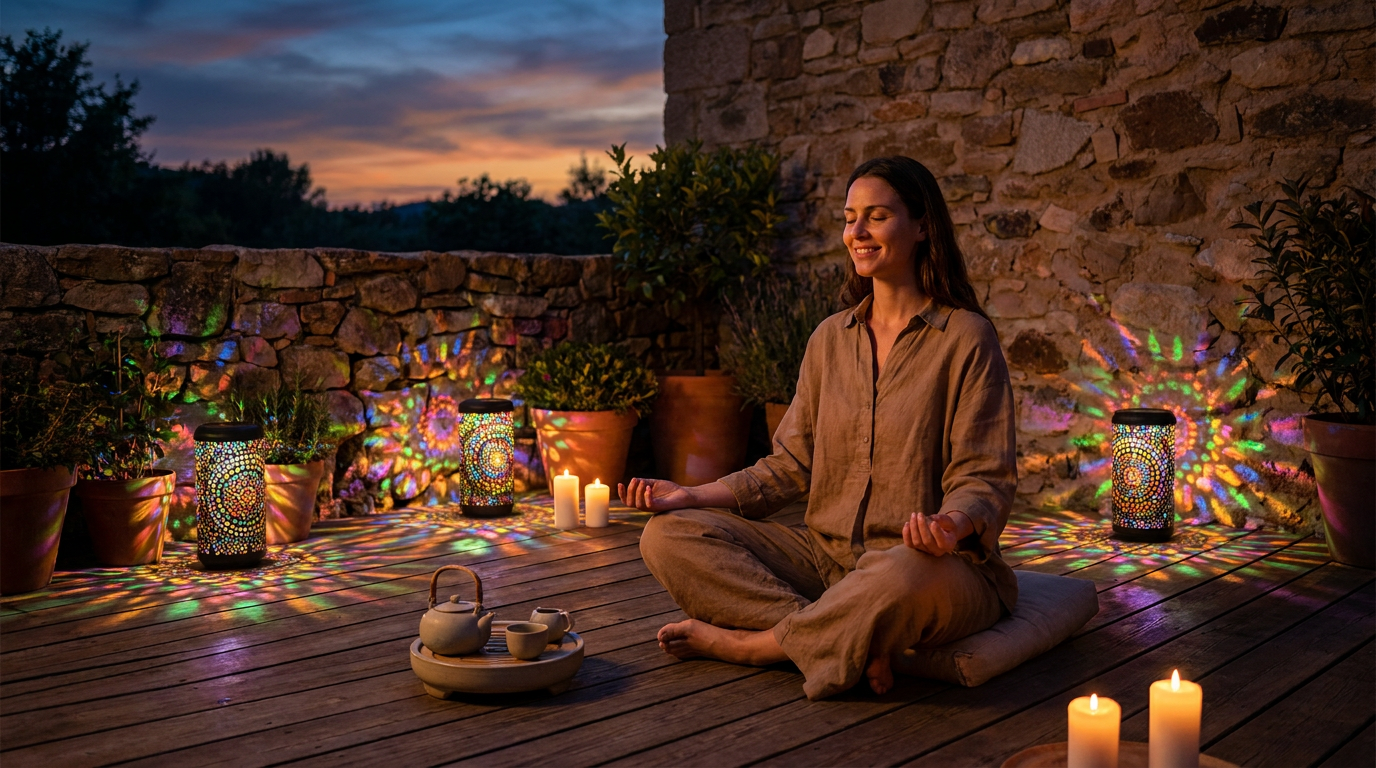
How to Use Solar Mandala Lights for Outdoor Meditation?
 Maya ChenContributing Editor
July 28, 2026 — Outdoor meditation spaces require low-lumen, high-contrast lighting like Solar Mandala Lights to facilitate focus without triggering the circadian disruption caused by standard floodlights.
The conventional wisdom says that brighter is better for safety, but for mindfulness, excessive illumination is a distraction. Homeowners often mistake general landscape lighting for functional meditation decor, failing to realize that a 2700K warm white glow is essential for maintaining a parasympathetic state. Solar Mandala Lights bridge this gap by using laser-cut apertures to project geometric shadows, grounding the practitioner in a specific visual field.
How does shadow projection enhance meditation focus?
Shadow projection creates a fixed visual anchor that mimics the rhythmic patterns found in natural environments, which is more effective for sustaining attention than static, flat lighting. While many designers suggest using LED floor lamps to save energy, these often lack the directional complexity needed to define a sacred space. Solar Mandala Lights function as both a light source and a visual tool; the intricate patterns projected onto the ground or nearby walls serve as a "drishti" or focal point. According to design principles highlighted by Glow Furniture Factory, lighting in these spaces should be intentional rather than incidental. Run the math: a standard 10-lumen solar stake provides basic visibility, but a mandala-style projector utilizes that same energy to create a 360-degree environmental texture that psychologically encloses a space without physical barriers.
Why is solar power preferred for quiet outdoor zones?

Photo by Jeric Turga on Pexels
Solar power eliminates the structural noise and installation requirements of hardwired systems, allowing for placement in isolated "quiet zones" where electrical infrastructure is absent. Many wellness guides, such as those from Serwall Outdoor, suggest using solar-powered string lights or lanterns to simulate natural transitions from day to night. I’ll change my mind when wired systems can offer the same portability without the hum of transformers or the visual clutter of conduits. Here’s the part nobody talks about: the passive nature of solar charging aligns with the minimalist philosophy of a zen garden solar mandala lights. By relying on the day's storage, the light intensity naturally wanes as the evening progresses, mirroring the user's descent into a meditative state. This creates a boho solar lantern garden effect that feels organic rather than industrial. For those integrating these into a larger boho solar lantern garden layout, the lack of wiring ensures the ground remains undisturbed for walking meditations.
Quick answers

Photo by JINU JOSEPH on Pexels
Q: What is the ideal lumen count for a meditation light? A: For a focused space, look for 5 to 15 lumens per Solar Mandala Light to ensure the shadow patterns remain crisp without causing glare. Higher outputs often wash out the intricate geometric designs.
Q: How long do Solar Mandala Lights typically stay illuminated? A: Most units equipped with a 600mAh Ni-MH battery will provide 6 to 8 hours of light following a full 8-hour charge in direct sunlight. Performance will drop by approximately 40% during overcast winter months.
Q: Can these lights be used in small balcony meditation corners? A: Yes, because Solar Mandala Lights project patterns outward, they can make a small 4x4 foot balcony feel more expansive by utilizing the vertical wall space for light play. Freedom Room notes that even a small backyard corner can benefit from such soft, patterned lighting to establish a routine.
Learn more about Solar Mandala Lights at https://solarmandalalights.com.