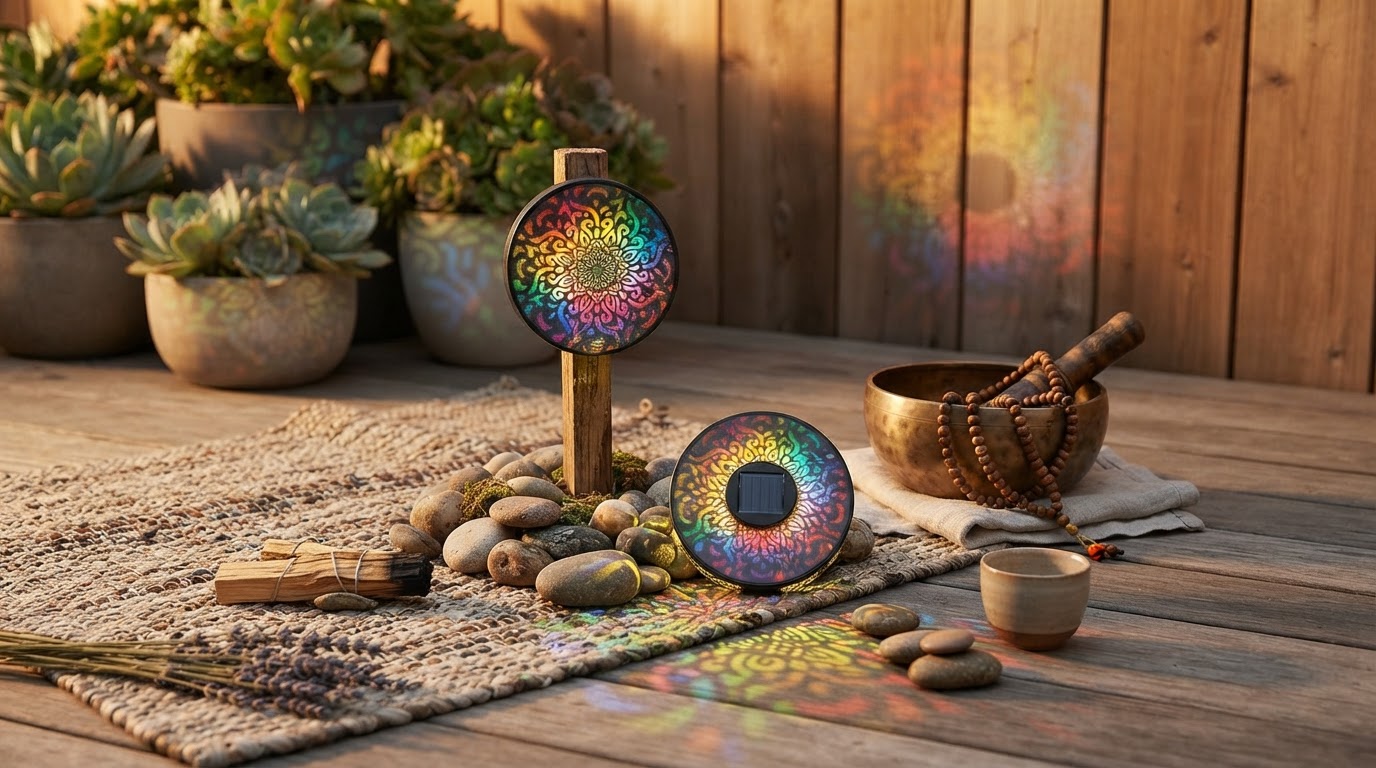
Solar Mandala Lights for Meditation Garden Design
 Maya ChenContributing Editor
October 14, 2026. This analysis evaluates the functional application of Solar Mandala Lights within private meditation spaces. It is intended for homeowners seeking to balance aesthetic shadow-play with the technical requirements of low-light mindfulness environments.
The Failure of Standard Zen Illumination
The conventional wisdom says that a meditation space requires high-intensity floodlighting for safety or, conversely, total darkness to foster introspection. Both approaches fail the practitioner. High-lumen output triggers a physiological alertness response that is antithetical to the parasympathetic activation required for deep meditation. According to Nature Hills Nursery, a successful meditation garden should prioritize themes that repeat for a visual sense of connection and continuity. Standard solar stakes, which provide a generic, diffuse glow, offer no such continuity; they merely mark a boundary without contributing to the meditative focus. Furthermore, many outdoor lighting designs rely on static, flat surfaces that do not interact with the surrounding flora. Here's the part nobody talks about: the psychological impact of "dead light"—light that occupies space without providing a focal point for the eye to rest upon. When a garden lacks a rhythmic visual element, the mind tends to wander toward the perimeter rather than settling into the center of the practice. This is why basic pathway markers often feel disjointed in a Zen garden lighting ideas framework, where every element must serve a singular purpose of tranquility.
Projection Physics and Solar Mandala Lights
Solar Mandala Lights address the deficit of visual rhythm through the use of laser-cut geometry. Unlike standard lanterns that utilize frosted glass to scatter light, these units employ high-contrast shadow projection. The physics of the mandala garden stake lights relies on a central LED source positioned to cast an unobstructed 360-degree pattern onto the ground. This creates a "shadow floor" that serves as a non-intrusive visual anchor. For those designing a yoga studio outdoor lighting area, the transition of these patterns across a patio or grass provides a geometric consistency that mimics traditional mandalas used in seated meditation. Data from search queries indicates a high demand for shadow pattern solar lights, specifically those that can function as mandala solar floor lights. The utility here is not just illumination, but the creation of a defined, sacred boundary. By utilizing solar moon mandala path lights, a practitioner can define the edges of their meditation zone without the harshness of wired electrical systems. The integration of solar lights for yoga garden setups allows for a placement flexibility that wired alternatives cannot match, particularly in the center of a lawn or a remote corner of a wooded lot where trenching for cables would disturb the root systems of the very plants intended to provide peace.
Evaluating Geometric Light for Mindfulness
Run the math: a standard solar light provides roughly 5 to 10 lumens of undirected light, whereas a mandala-specific unit focuses that energy into high-contrast silhouettes. When selecting hardware for a solar lights for yoga garden project, the decision should be based on pattern density and battery efficiency rather than raw brightness. A meditation garden requires a specific hierarchy of light. The following framework should guide the selection of Solar Mandala Lights to ensure they complement rather than distract from the practice. First, verify the projection radius; a mandala garden stake should ideally project a pattern that covers at least three feet in diameter to provide a sufficient visual base. Second, assess the color temperature; a warm white (2700K to 3000K) is necessary to avoid the blue-light spectrum that interferes with melatonin production. Third, consider the placement height. While hanging solar mandala lanterns are effective for overhead ambiance in a yoga studio outdoor lighting context, ground-level stakes are superior for grounding the gaze during seated postures. Fourth, ensure the solar panel is integrated into the top of the unit to maximize UV absorption in a zen garden lighting ideas layout that may have partial shade from maples or bamboo. Fifth, check for weather-resistant casing that protects the laser-cut apertures from debris. I'll change my mind when a study proves that flat, featureless light is more conducive to alpha brainwave states than rhythmic, geometric patterns. Until then, the evidence favors the intentionality of mandala-based projections.
Shop Solar Mandala Lights here.
Sources
- Zen Garden Lighting - Pinterest
- Japanese Garden Lighting Ideas | Peaceful Zen Illumination Design
- How to illuminate a ZEN garden - SIMES Blog